A place to stay: refurbishing to make room for life
3 September 2026
Moisés Royo · 01 June 2026 · Villa · Refurbishment
At Villa Uruguay, sculpture is not treated as an object added to a finished setting. Distance, scale, daylight, water and landscape establish the precise conditions through which art becomes part of the architecture.
A work of art does not end at its own surface.
It needs distance.
Scale.
Light.
A background.
And a place from which to be seen.
At Villa Uruguay in Marbella, the arrival of a sculpture raised a question that belongs as much to architecture as it does to display: what happens when art is no longer treated as something placed inside a completed space, but as a presence capable of reshaping the relationships around it?
The task was not to identify an empty area large enough to contain the work.
It was to find where the work belonged.
Bringing art into a home is not simply a matter of finding available wall or floor space.
Position determines encounter. The first view matters, as do the distance from which a work can be read, the background against which it appears, the quality of daylight and the elements that share its visual field.
Here, the work is The Future is a Big Kiss Totem by Belgian artist Isabelle Scheltjens, a sculpture carved in white marble.
Its elongated presence calls for space around it. It needs to be approached, seen against changing backgrounds and allowed to register differently from one viewpoint to the next. Architecture establishes these conditions without turning the setting into a conventional gallery.
The sculpture is not an object added after the architecture is complete.
Its placement completes a spatial relationship.
The chosen position establishes a deliberate sequence.
Water in the foreground.
The sculpture beyond it.
And the sea in the distance.
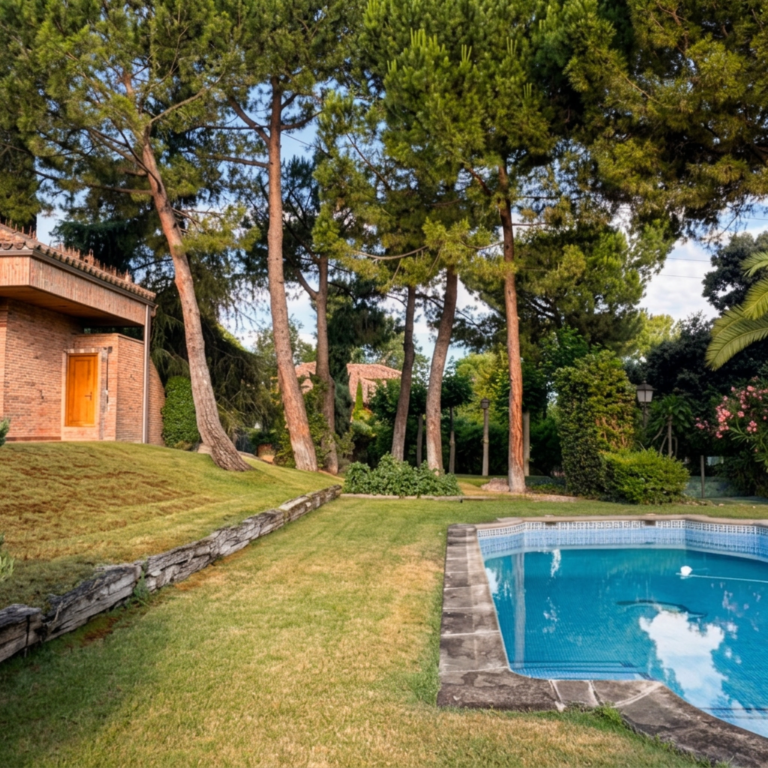
The work sits between two liquid horizons. The nearer surface introduces reflection and movement; the distant landscape gives the composition depth. From different positions, the white marble can be read against the architecture, the sky or the Mediterranean itself.
The sculpture is therefore never entirely isolated from its setting.
Its presence depends on what surrounds it.
And, in return, it changes the way that setting is perceived.
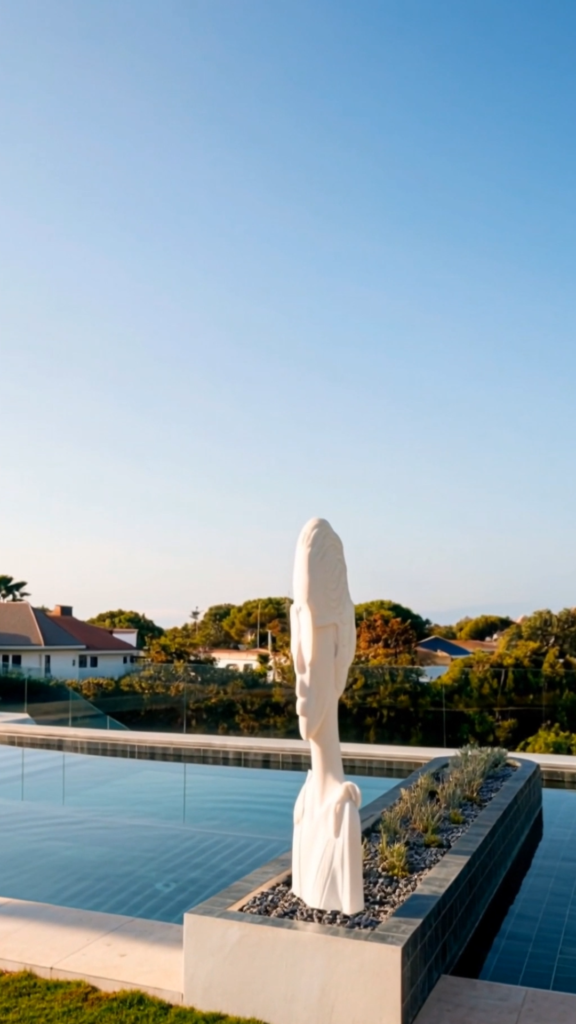
White marble has an unusually sensitive relationship with daylight.
Its appearance is never completely fixed. Direct sun, softer reflected light and shadow reveal different depths and contours across a surface that may initially appear uniform.
Architecture participates in this transformation through orientation, distance and background.
Morning, midday and late afternoon produce different relationships between sculpture, water and landscape. Reflections shift, shadows move and the outline of the piece becomes more or less pronounced.
The object remains.
The scene does not.
Distance and perception have long been central to Isabelle Scheltjens’ practice.
The Belgian artist first became known for glass-fusing portraiture, developing images whose reading changes dramatically as the viewer moves closer or further away. Her practice later expanded into sculpture, including works in marble and bronze, carrying her investigation of faces, light and perception into three dimensions.
Her sculptural figures are elongated and visually commanding, revealing different readings as the viewer moves around them.
At Villa Uruguay, this concern with viewpoint finds a particularly architectural setting. The work is not given one privileged frontal view; it is encountered through movement, as the relationship between body, water, architecture and horizon continually changes.
There is a straightforward way to combine art and architecture: allow one to act as the backdrop for the other.
The relationship can be richer than that.
When the two genuinely meet, each changes the other.
Architecture provides scale, sequence, light and distance. Art introduces a new point of intensity, redirects views and gives a different weight to a place that previously had another spatial reading.
The sculpture makes the space around it more visible.
The space allows the sculpture to acquire new meanings.
Neither needs to dominate.
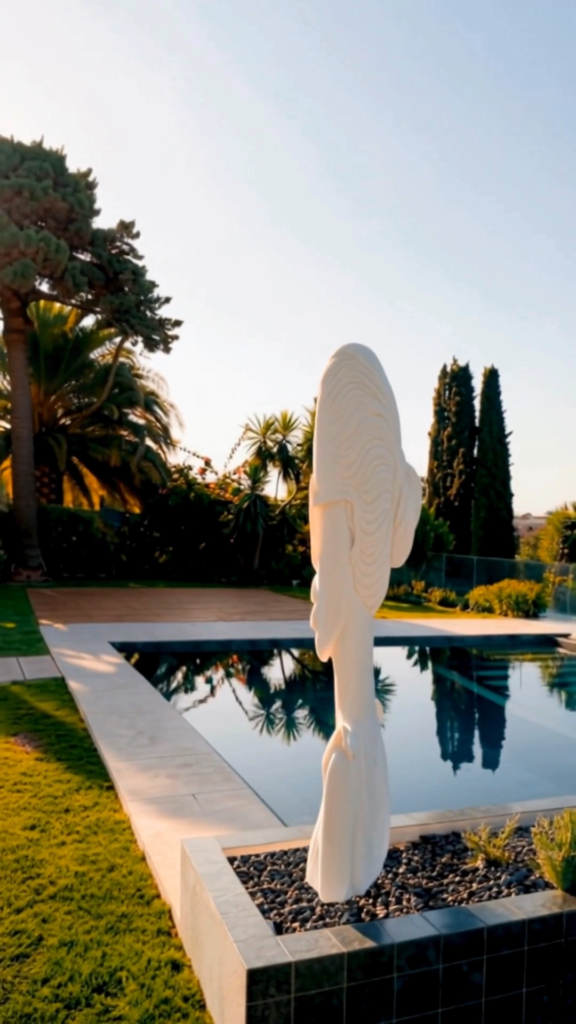
Some architectural decisions can be drawn with complete precision: an axis, a dimension, a distance, a line of sight.
Yet their effect often belongs to something much harder to document.
The moment the sculpture first appears on approach.
Its reflection on the water.
White marble against the horizon.
The change that comes with late-afternoon light.
At Villa Uruguay, finding a place for the sculpture meant designing all of these relationships at once.
Because art does not end at the object.
And architecture does not end at the edge of the building.
When the two are allowed to transform one another, something else emerges:
a new presence.