Invisible decisions: concrete at Casa Fuensanta
6 April 2026
Moisés Royo · 08 may 2026 · Competitions
In Tokyo, IN-BETWEEN reimagines the cemetery as a vertical place of transition. Concrete, timber, gardens, daylight and void create space for memory while respecting Japanese funerary customs.
Some architectures are built around presence.
Others have to learn how to work with absence.
IN-BETWEEN begins with the latter.
Set in Tokyo, the proposal reimagines the cemetery vertically: a place capable of responding to the need for density while retaining the intimacy and pause that remembrance requires.
The architecture does not attempt to represent death.
It creates a place for those who remember.
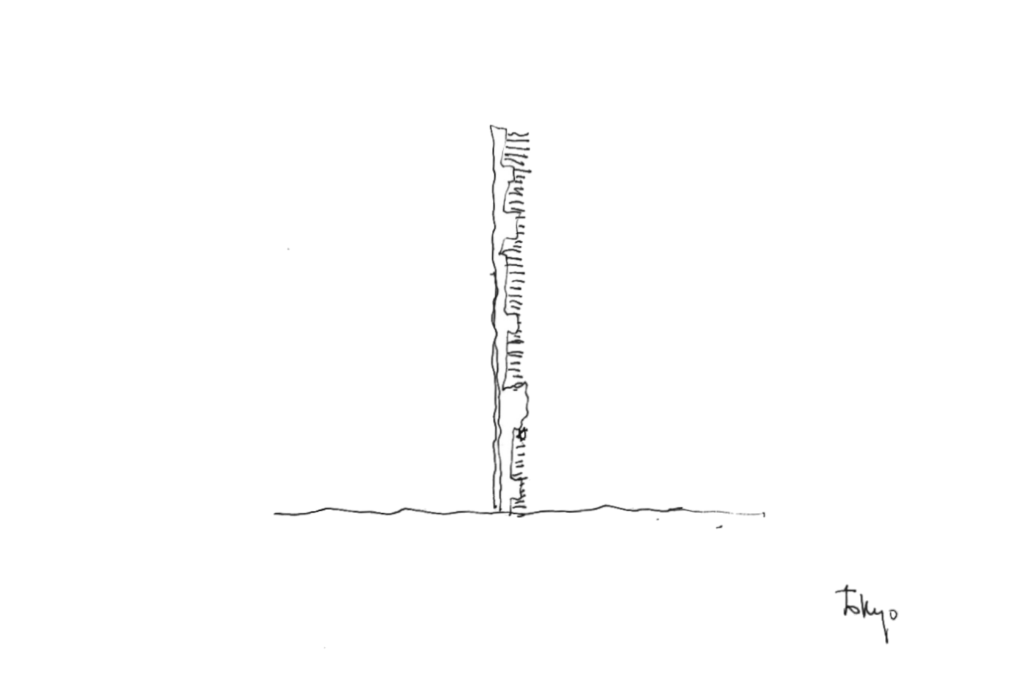
The project is structured around a deliberate material opposition.
Concrete.
Timber.
The solidity of concrete establishes weight, permanence and stability. Timber introduces a different register: warmer, closer and more tactile.
These are not simply two finishes placed alongside one another.
Each helps define a distinct condition within the building.
The architecture emerges through the tension between them: permanence and warmth, mass and lightness, distance and proximity.
Between these two conditions lies the project’s real centre.
A void.
Air.
Gardens.
Daylight.
Movement.
A space that belongs fully to neither side, yet connects them both.
Hence the name: IN-BETWEEN.
The intermediate space is not leftover space. It is where transition takes place and where the cemetery moves beyond pure function to provide pause, movement and contemplation.
The void is architectural too.
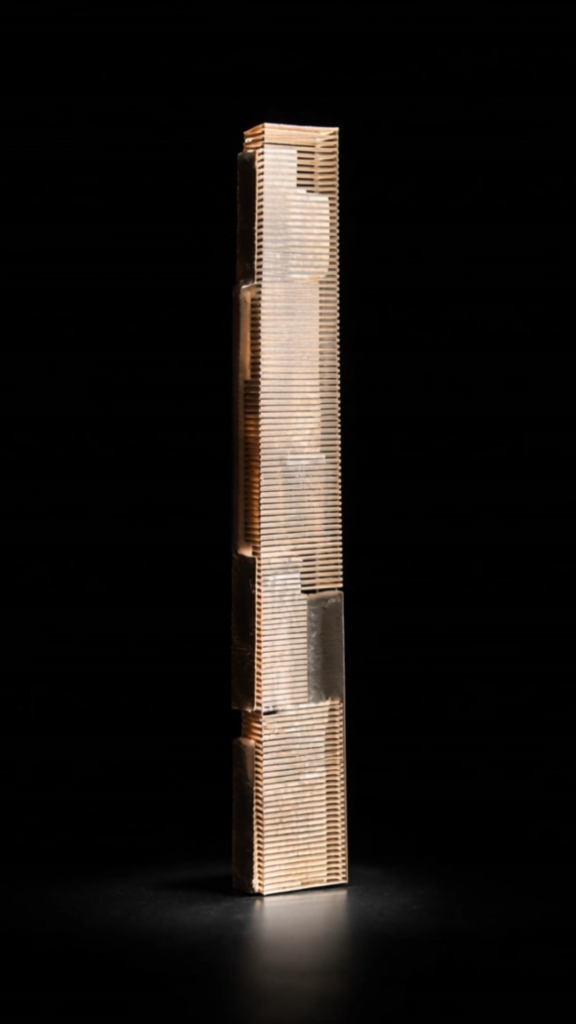
Building vertically requires a typology traditionally associated with the ground to be reconsidered.
The proposal uses a precise grid to organise the graves and achieve the necessary density.
Yet compactness is not treated as a storage problem. Density has to coexist with dignity, orientation and respect for Japanese funerary customs.
The grid establishes order.
Between its parts, however, spaces for daylight, planting and distance remain essential.
Compactness does not have to erase experience.
It can create a different framework for it.
A cemetery does not belong only to those who are no longer there.
It also belongs to those who return.
To people who walk through it, pause, remember and maintain a relationship with absence.
IN-BETWEEN therefore shifts attention away from representing death and towards the experience of memory.
Architecture does not need to explain loss.
It can accompany it.
Through shade, daylight, silence, planting, distance and a route that briefly interrupts the pace of ordinary life.
In a project of this kind, materials never act alone.
Concrete gains depth through light. Timber changes the perceived scale of the space and brings it closer to the body. Gardens introduce living, changing matter between elements intended to endure.
Movement connects these conditions.
There is not only a destination.
The time taken to reach it matters too.
Transitions between materials, between interior and garden, between brightness and shadow allow movement itself to become part of the project’s meaning.
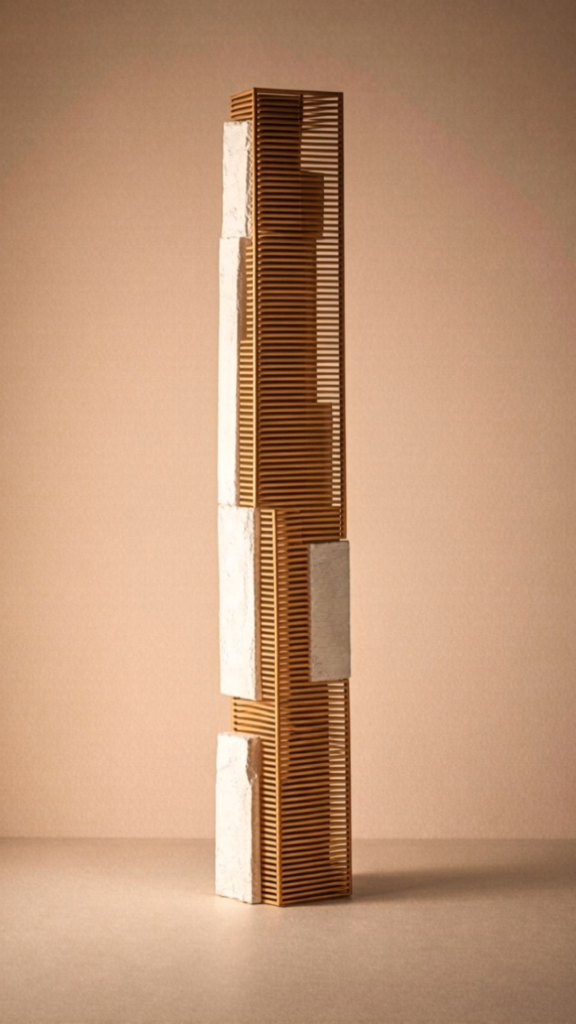
IN-BETWEEN does not attempt to resolve absence through an image.
Instead, it creates a place where different conditions can coexist.
Solid and warm.
Built and planted.
Memory and everyday life.
Presence and absence.
Between them is a space that belongs entirely to neither.
Perhaps that is precisely where architecture has something to offer.
Not by representing what cannot be represented.
But by providing a place from which to remember.
IN-BETWEEN received second prize in the international Arch Out Loud competition.
The recognition reflects a proposal that brings together the density required by a vertical cemetery, respect for Japanese funerary customs and the more intangible dimension of architecture for remembrance.
Compact in its organisation.
Yet open to air, daylight and time.