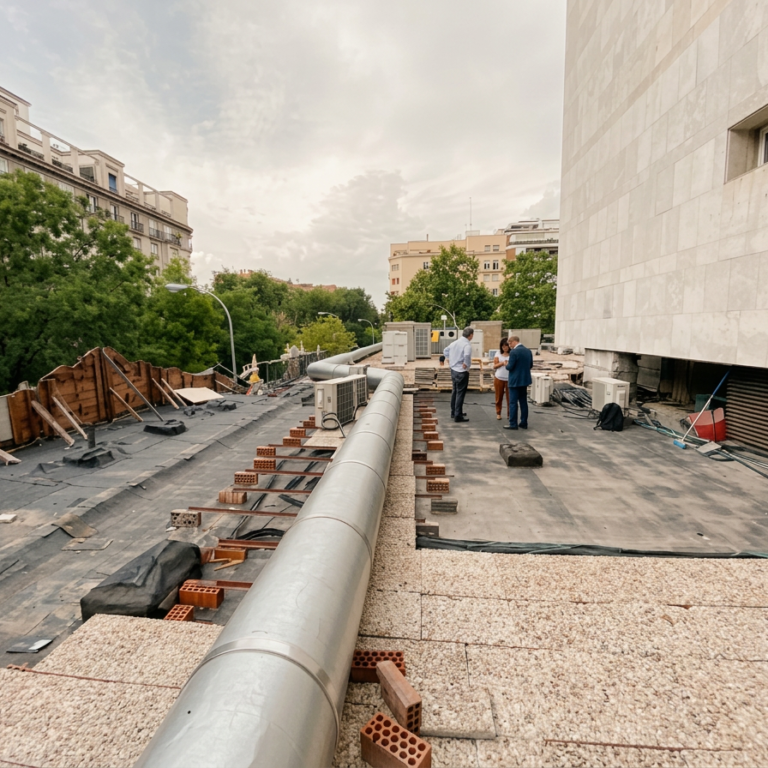
Would you put 45 tonnes of water on a building’s roof?
5 October 2026
Moisés Royo · 26 June 2026 · Architectural Expert Reports
The value of an expert report lies not in accumulating data, but in knowing how to connect it
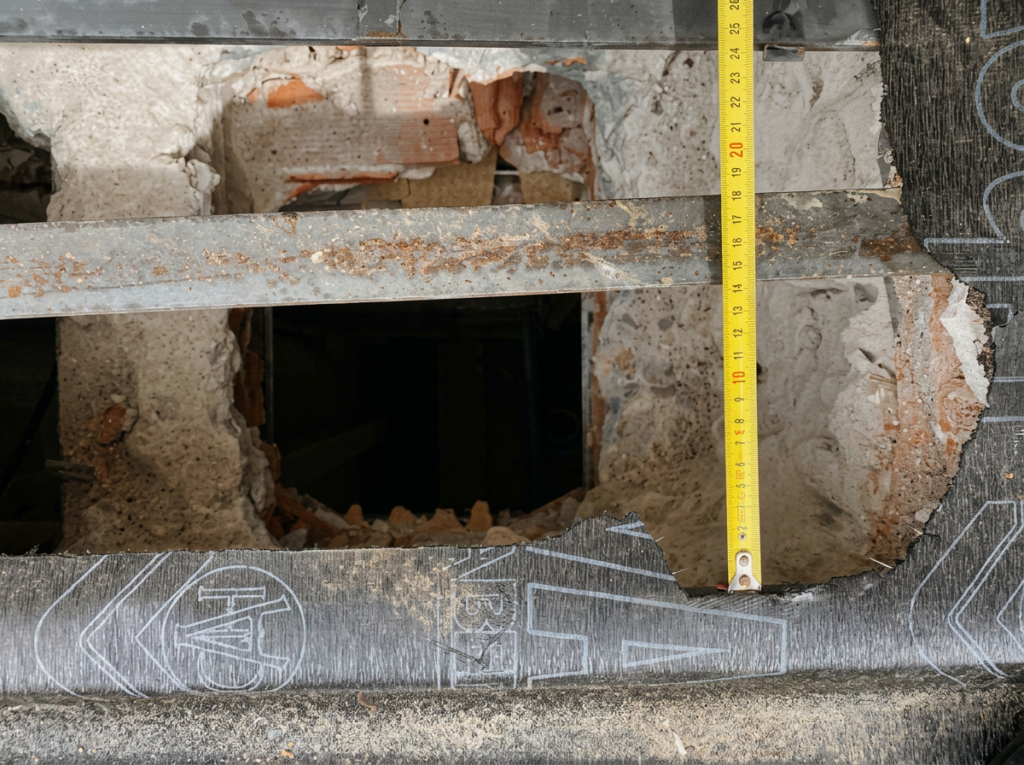
Three very different examples – an opening in a floor slab, 45 tonnes of water planned for a roof, and a foundation that would not fit as drawn – reveal why architectural expert assessment requires looking across disciplines. The visible problem is rarely the whole story
Two people can look at exactly the same building work and yet not see the same thing.
For an architect acting as an expert, a photograph is more than an image: it can confirm a geometry, provide evidence of a structural bearing point, reveal the actual position of an installation, or offer the clue that leads back to the design documentation to review how an element was intended to perform.
Expert assessment is precisely about turning this collection of clues into a coherent technical reading. Drawings, specifications, bills of quantities, site records, photographs, regulations, inspections and administrative documentation are cross-checked against one another. None of these documents tells the whole story on its own.
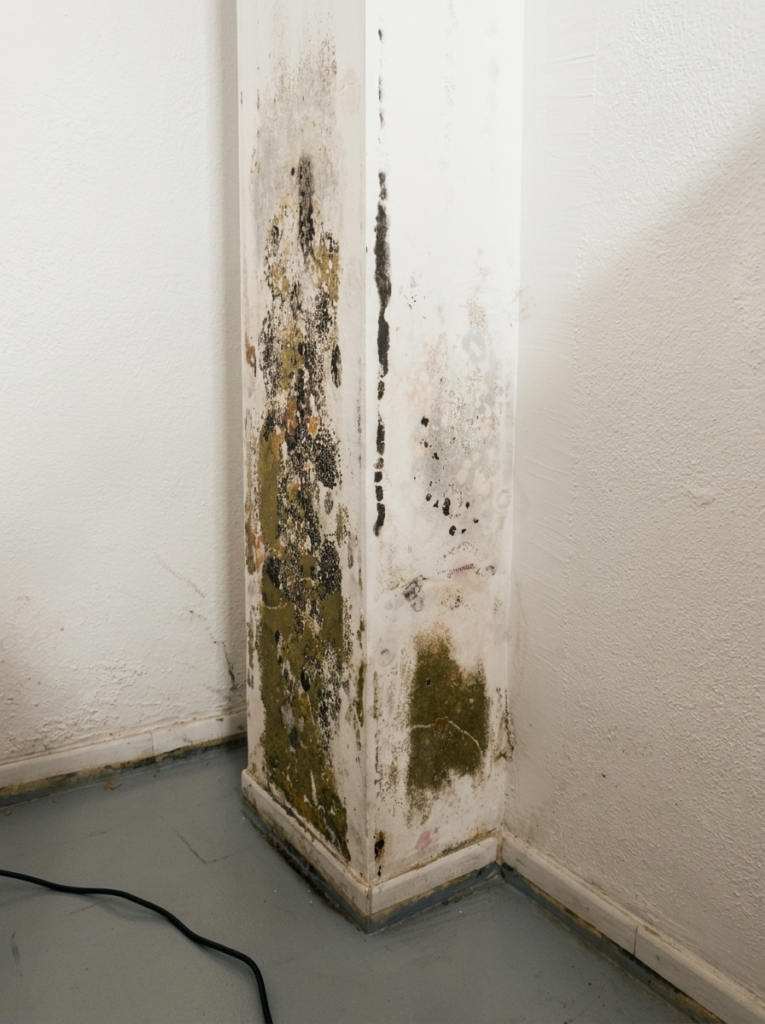
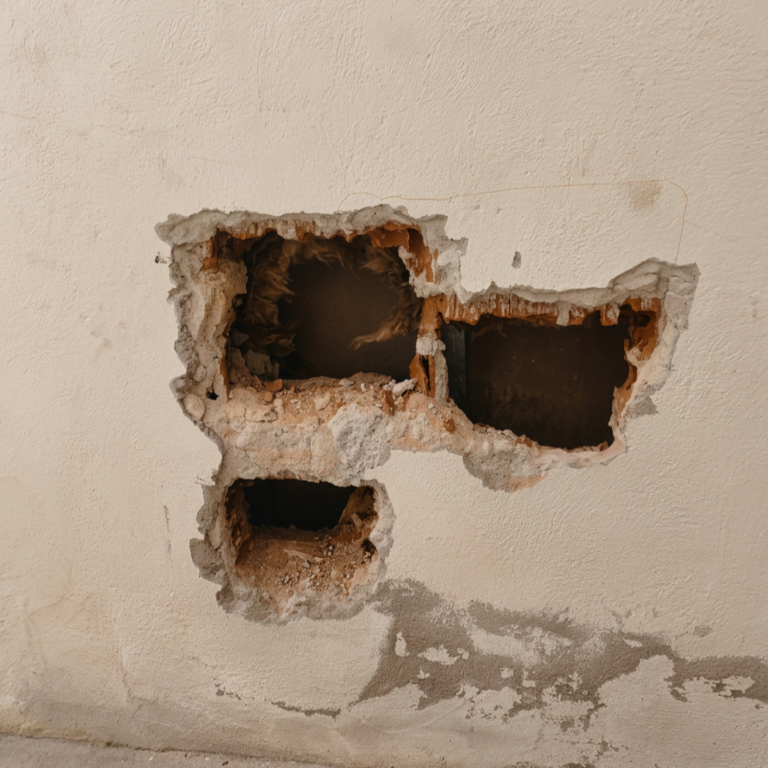
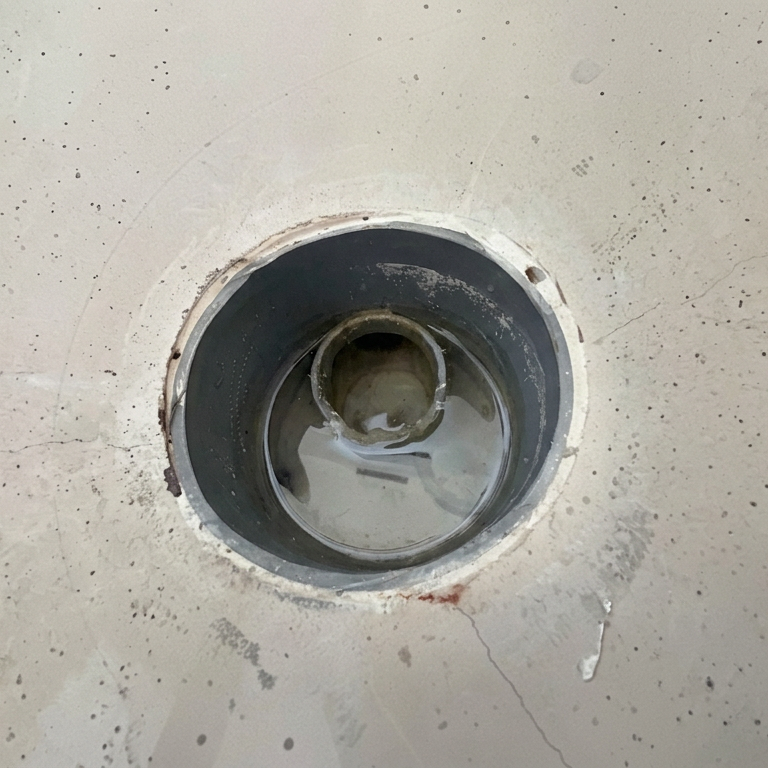
The reports on which this series is based contain very different examples. At a sports facility, a site visit established that numerous completed elements were in good condition, while the documentary analysis revealed significant inconsistencies in the structural definition of the design. In another case, the inspection of commercial premises and the common areas of a residential building required drawings, municipal records and the as-built conditions to be compared in order to identify openings in floor slabs, new installations and proposed loads on the roof.
What matters is not each finding in isolation, but the relationship between them. A foundation may be correctly drawn and yet fail to fit within the space actually available. A tank may physically fit on a roof and still require a much more thorough structural assessment. An opening may appear to be a simple penetration until the role of the slab it passes through is properly understood.
There is a common misconception that an expert arrives on site to find defects. A rigorous report works in precisely the opposite way: it must be capable of confirming an anomaly where one exists, but also of ruling out a concern or recognising work that has been correctly executed.
In the report on the sports facility, the enclosures, surfaces, bearing points, steel structure and tensile roof were reviewed. The visual inspection recorded that several of these elements were in good condition. This objectivity is essential, because the credibility of the analysis depends on distinguishing between what can be observed, what can be demonstrated and what can only be put forward as a hypothesis.
Expert assessment is not a matter of working through an automatic checklist. Every building raises different questions. Does the as-built geometry match the design? Do the loads considered in the calculations actually correspond to the location? Does a new installation affect common elements? Has the structure been altered? Do the certified items correspond to the work actually carried out?
Professional expertise comes into play when these questions are asked at the right moment and when one knows where to look for the answer. Sometimes it will be found in a drawing; sometimes in a site photograph; sometimes in a regulation; and often it only emerges when several sources are cross-referenced.
When a technical discrepancy arises, what can be seen is often only the final manifestation of the problem: halted works, a financial claim, concerned residents or doubts about safety. An expert report works backwards, seeking to reconstruct the process that led to that point.
It is this capacity for reconstruction that makes expert assessment a useful tool. The aim is not to add another opinion, but to organise the facts so that they can be understood and, where necessary, discussed on the basis of verifiable technical evidence.
Expert knowledge is not simply about seeing more. It is about knowing how to connect what others see separately
Our work is to reconstruct that history through drawings, regulations, site visits, measurements and documentation, and turn it into conclusions that can be technically substantiated.
At MUKAarquitectura, we approach expert reports through an integrated reading of the design, construction, regulations and documentation. If you need to understand the origin and extent of a construction issue, the first step is to reconstruct, from a technical perspective, what has happened.