Who is responsible for a damaged communal soil stack?
13 October 2026
Moisés Royo · 13 October 2026 · Architectural expert reports
Damp in a basement does not, in itself, identify its source. The position of the staining, the route of the services and nearby deformation may provide clues, but diagnosis requires these to be verified before repairs are carried out or responsibility is attributed
Damp in basements is one of the most difficult building defects to diagnose correctly because the same symptom can have very different causes.
A stain at the lower part of a wall may be associated with groundwater, defective waterproofing, a buried service, a soil stack, a drainage network or even a combination of several factors.
For that reason, investigation is necessary before any repair is carried out.
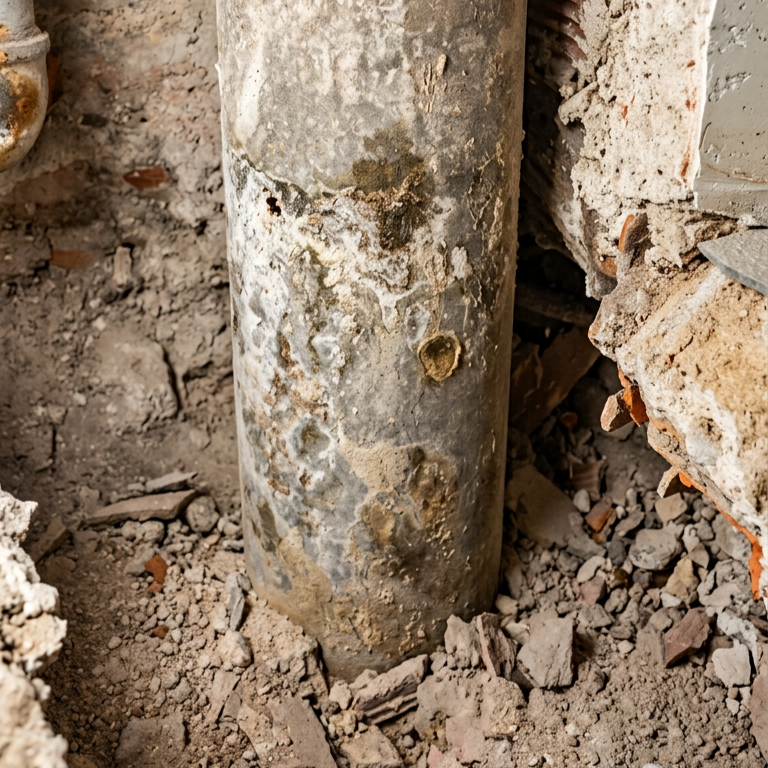
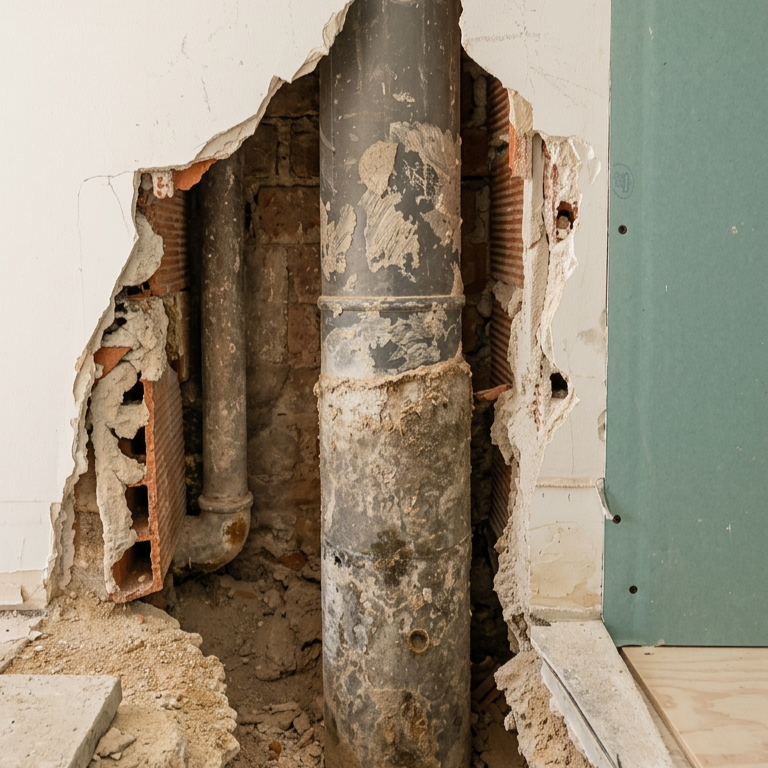
In a recent case, inspection of a communal soil stack at ground-floor level required the analysis to continue into the basement. Its continuation was located by geometric correspondence in the service boxing. Nearby, there was damp at the lower parts of the walls together with a ceramic floor finish that had bulged and partially lifted.
Does that prove that there is a broken pipe beneath the floor? No. But the spatial correspondence between the drainage stack, the possible route of the buried network, the damp and the deformation of the floor constitutes a sufficiently significant set of indications to justify further investigation.
This principle is essential in building pathology: a single indication is not conclusive evidence, but several consistent indications can guide the diagnosis very effectively.
Leaks from a buried drainage network can remain concealed for a considerable time. Depending on the construction, water may saturate fill, mobilise fine material, degrade finishes or cause damp in nearby building elements.
The investigation should begin by reconstructing the route of the system. It is necessary to establish where the soil stack runs, where it becomes horizontal, what access points exist and which areas can be opened up with the least possible damage.
From there, different checks may be considered: selective opening-up at strategic points, watertightness testing, camera inspection, checking joints or localised trial openings.
It is equally important not to state more than the evidence allows. Seeing a bulging floor beside a soil stack does not automatically justify concluding that there is a drainage leak. Likewise, damp in a basement does not in itself allow the conclusion that there is a structural or foundation problem.
Identifying the possible source of damp is only one part of the analysis. Where several owners are involved or a community of property owners is concerned, technically establishing the cause is essential before responsibility is attributed.
Architectural expert work consists precisely in distinguishing between observed facts, technically compatible hypotheses and issues requiring further verification.
This approach avoids two common errors. The first is repairing only the symptom: repainting the wall, replacing tiles or applying a finish without eliminating the source of the water. The second is carrying out major building work based solely on an unverified hypothesis.
A good diagnostic strategy seeks to obtain the maximum amount of information with the minimum number of destructive interventions, while documenting the initial condition, the tests carried out and the final outcome.
When there is a dispute involving a community of property owners, an individual owner, commercial premises, a contractor or an insurer, this documentation becomes even more important. Once an element has been opened up, repaired and closed again, essential evidence for determining the origin of the damage may disappear.
For this reason, where the cause of damp is unclear or there may be overlapping responsibilities, it may be advisable for the inspection to be carried out by an independent technical professional before repairs begin.
Moisés Royo Márquez is a Doctor of Architecture, court-appointed architectural expert and COAM-registered architect no. 17,419. At MUKA arquitectura, he prepares technical and architectural expert reports to diagnose building defects, document damage and define repair interventions in existing buildings and communities of property owners