Older fibre-cement soil stacks: defects, weak points and when replacement is advisable
13 October 2026
Moisés Royo · 13 October 2026 · Architectural expert reports
A damaged soil stack is discovered during renovation work. Determining who is responsible requires distinguishing between when the defect was discovered and what actually caused it
Deteriorated communal soil stack analysed in
an architectural expert report
A small perforation in a communal soil stack can trigger a significant dispute between a community of property owners and the owner of commercial premises. If the damage is discovered while the premises are being renovated, the first conclusion may seem obvious: “the building work damaged the soil stack”.
From an architectural expert perspective, however, discovering damage during construction does not prove that the work caused it.
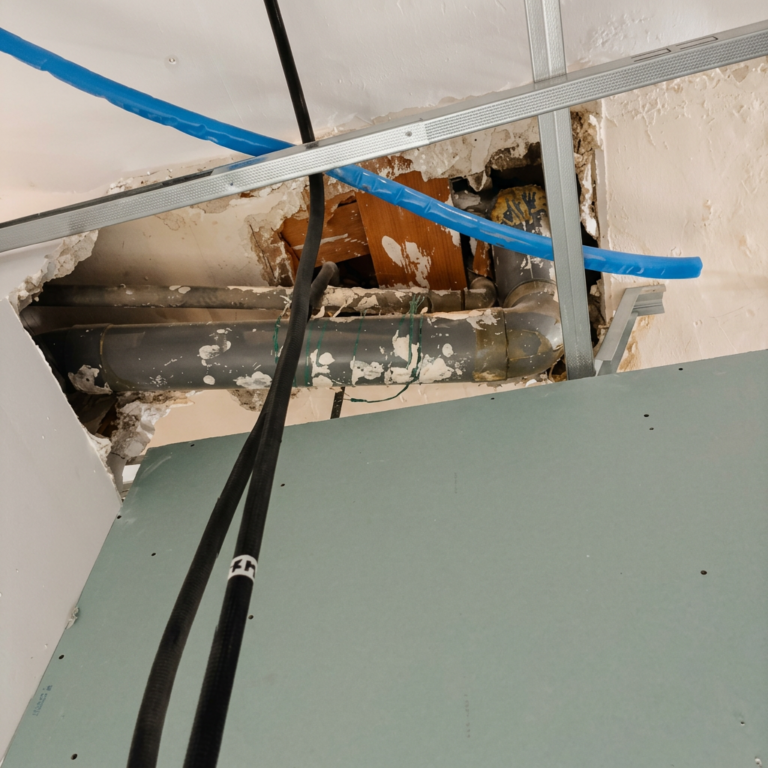
In a recent case analysed by MUKA arquitectura, opening up the enclosures of commercial premises during renovation work provided access to a communal soil stack that would normally remain concealed. A small perforation was found in it. The community questioned whether the damage could be attributed to the work being carried out in the premises.
The inspection revealed a more complex situation. The upper section of the soil stack had been renewed in PVC, while the lower section remained the original fibre-cement pipe. Between the two was a clearly deteriorated material and geometric transition.
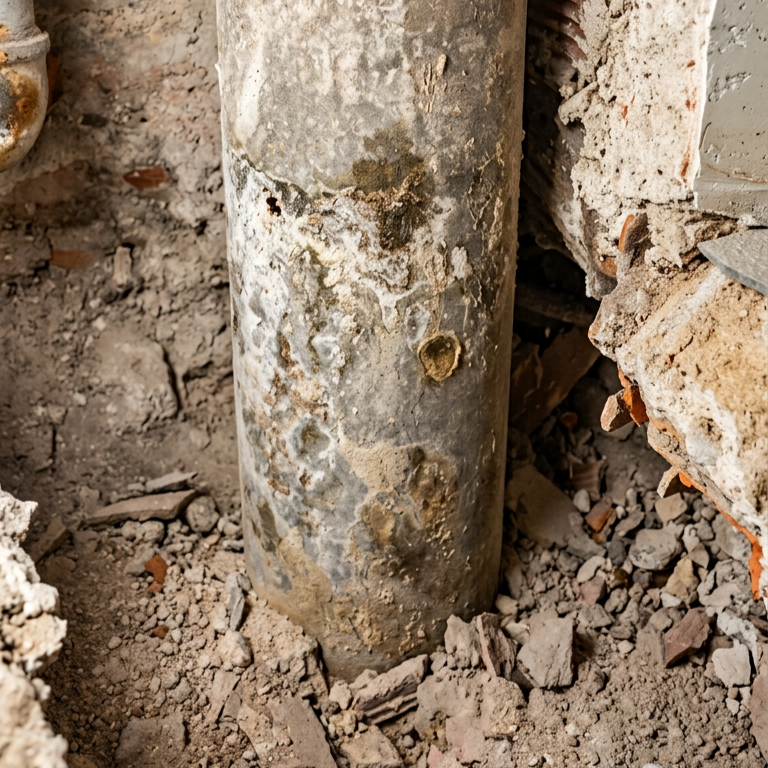
The older section showed signs of ageing, deposits, surface irregularities, indications consistent with damp and localised material loss. It was within precisely this context that the perforation appeared.
When a soil stack retains older sections of fibre cement, the analysis should not be limited to the specific point where the defect appears. The overall condition of the pipe and, in particular, the connections with renewed sections may be decisive.
Not necessarily. To attribute a defect technically to a specific piece of work, additional evidence would be required: an unequivocal impact mark, before-and-after photographs, a dated record of the damage, direct testimony or any other objective evidence capable of reconstructing the causal mechanism with sufficient certainty.
In this case, the morphology of the hole made it possible to identify localised material loss, but not to establish when it had occurred or which specific agent had caused it.
Nor could it be completely ruled out that a tool or recent handling had contributed to causing or enlarging the defect. But possibility and proof are not the same thing.
The architectural expert conclusion therefore had to remain cautious: there was insufficient objective technical evidence to attribute the damage to the owner of the premises solely because it had been discovered during the building work.
The analysis did not end at the hole. The route of the soil stack was followed down into the basement, where other signs appeared: damp at the lower parts of the walls and deformation of the floor close to the likely route of the drainage system.
These symptoms did not automatically prove a break in the buried drainage network either, but they justified further investigation through selective opening-up, watertightness testing and, where the geometry allowed, internal camera inspection.
When faced with a small hole, it can be tempting to limit the intervention to patching it. However, when the element as a whole is in poor condition, a local repair may conceal a larger problem.
In this case, the technically reasonable solution was to replace the deteriorated older section and then verify watertightness before closing the enclosures again.
The renovation of the premises also offered an opportunity: the installation was accessible. Closing the area and having to open it up again a few months later would have multiplied costs and disruption.
In disputes of this kind, three issues should be kept separate: which element is affected, which cause can be technically demonstrated and what legal responsibility may subsequently arise. An independent architectural expert report should not begin by looking for someone to blame; it should begin by documenting the evidence.
Moisés Royo Márquez is a Doctor of Architecture, court-appointed architectural expert and COAM-registered architect no. 17,419. At MUKA arquitectura, he prepares technical and architectural expert reports on building defects, damp, water ingress, communal installations and disputes between property owners, communities of property owners and construction companies