Who is responsible for a damaged communal soil stack?
13 October 2026
Moisés Royo · 13 October 2026 · Architectural expert reports
Older soil stacks can continue to function for years without showing obvious symptoms. However, renovation work or localised opening-up may reveal deterioration, vulnerable connections and defects that make it advisable to assess the system as a whole rather than limiting the intervention to a local repair
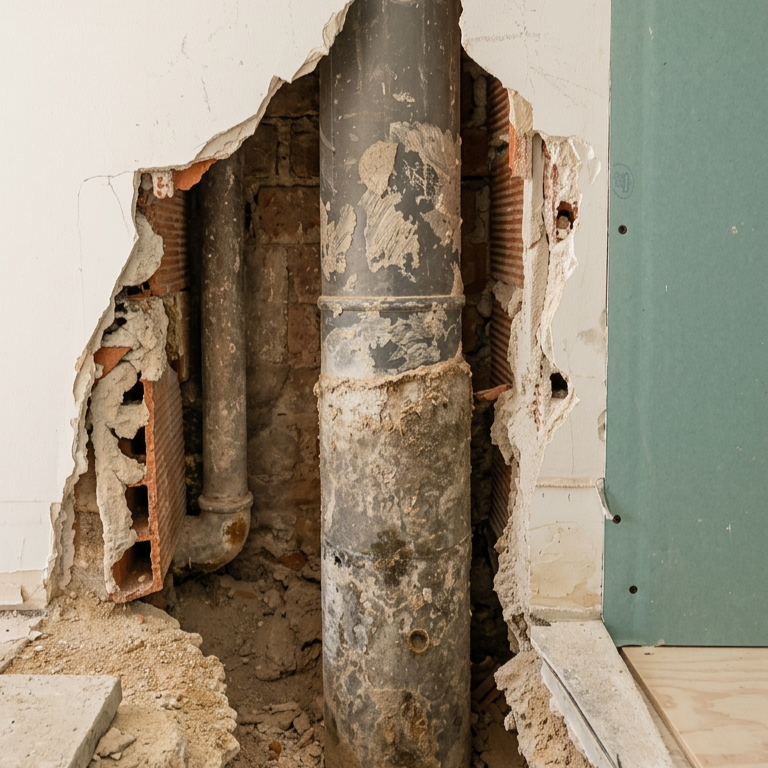
Bajante antigua de fibrocemento con signos de deterioro
Many buildings constructed decades ago still retain their original fibre-cement soil stacks. Some appear to function without problems for years, until renovation work, a leak or opening up a wall reveals a condition far worse than expected.
One of the most common situations is the partial renewal of an installation. Part of the soil stack is replaced with PVC, while the original section is retained on the lower floors or where it passes through floor slabs. The result is an installation made up of different materials, stiffnesses, geometries and jointing systems.
These transitions require particular attention.
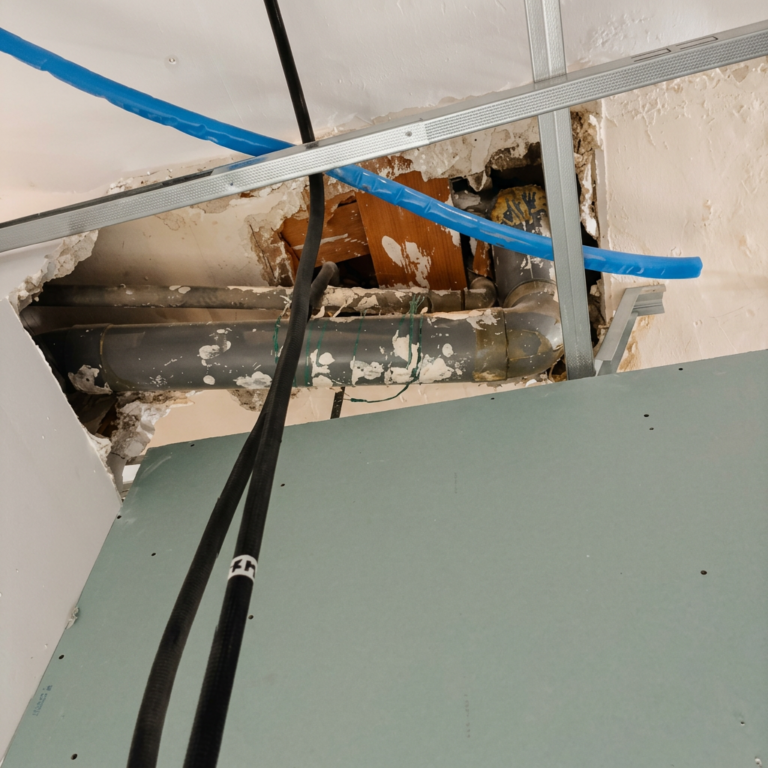
In a recent inspection carried out by MUKA arquitectura, a soil stack was found with an upper section renewed in PVC connected to an older lower section of fibre cement. The deterioration was concentrated around the junction.
Why are these points vulnerable? Because a homogeneous installation distributes actions more evenly. By contrast, a connection between elements of different stiffness can concentrate small stresses, vibrations, movements or defects associated with ageing.
Signs that should raise concern include surface disintegration, deposits or build-up, damp staining, cracks, material loss, irregular joints and small perforations.
It is important not to analyse an isolated defect separately from the overall condition of the pipe. A small hole may appear repairable with a patch, but if the pipe shows general degradation and loss of strength, a local repair may not resolve the underlying defect.
In these cases, it should be assessed whether replacing the entire section until a part of the installation in verifiable condition is reached would be more appropriate.
Deterioration of a soil stack does not always manifest itself in the pipe itself. Where the drainage network continues beneath the floor, nearby damp or deformation may justify a wider investigation.
Access opportunities should also be used effectively. When renovation work has opened up a service boxing, suspended ceiling or enclosure that would normally conceal a communal installation, it may be far more efficient to inspect and renew the deteriorated section at that point than to close it and demolish it again later.
The intervention should always end with verification. Replacing a pipe without checking its watertightness does not properly complete the diagnostic and repair process. Depending on the case, hydraulic tests, joint checks, access inspections or camera inspection may be required.
Another issue requiring particular caution is the nature of fibre cement itself. Before cutting, drilling or removing an older element made from this material, it must be established whether it contains asbestos and, where applicable, the relevant specific procedure must be followed. Its handling should not be improvised during building work.
Particularly where there is widespread deterioration, multiple defects, repeated leaks, incompatible or vulnerable joints, temporary accessibility during renovation work or signs of problems in concealed sections.
The aim should not simply be to stop the leak from being visible. The objective should be to restore a continuous, watertight, maintainable and documented drainage system.
Moisés Royo Márquez, Doctor of Architecture and court-appointed architectural expert, directs MUKA arquitectura and prepares building pathology and diagnostic reports for existing buildings, communities of property owners and disputes arising from construction defects or communal installations