IN-BETWEEN: architecture between memory and absence
8 May 2026
Moisés Royo · 08 October 2026 · Competitions
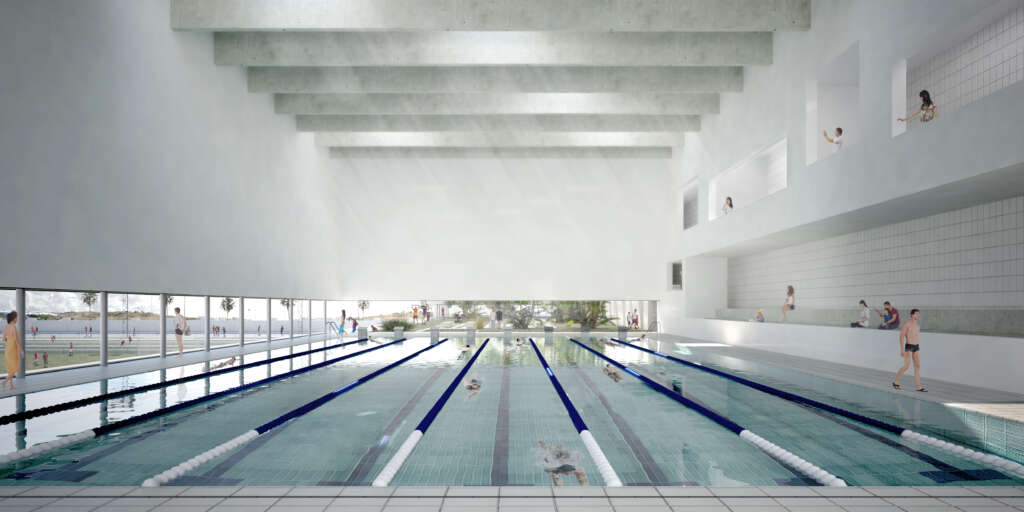
Beside San Bernardo stadium, the proposal turns an indoor swimming pool into an open, recognisable civic presence connecting sport, public space, planting and landscape
In Estepona, the position of the new indoor pool beside San Bernardo stadium meant that the project could be understood as more than the resolution of a sports programme.
The building had the opportunity to participate in the city: to become recognisable, activate its surroundings and establish new relationships between sport, public space, planting and landscape.
The intention was not simply to add another swimming pool.
It was to create a piece of civic architecture capable of extending what a sports facility can contribute to its setting.
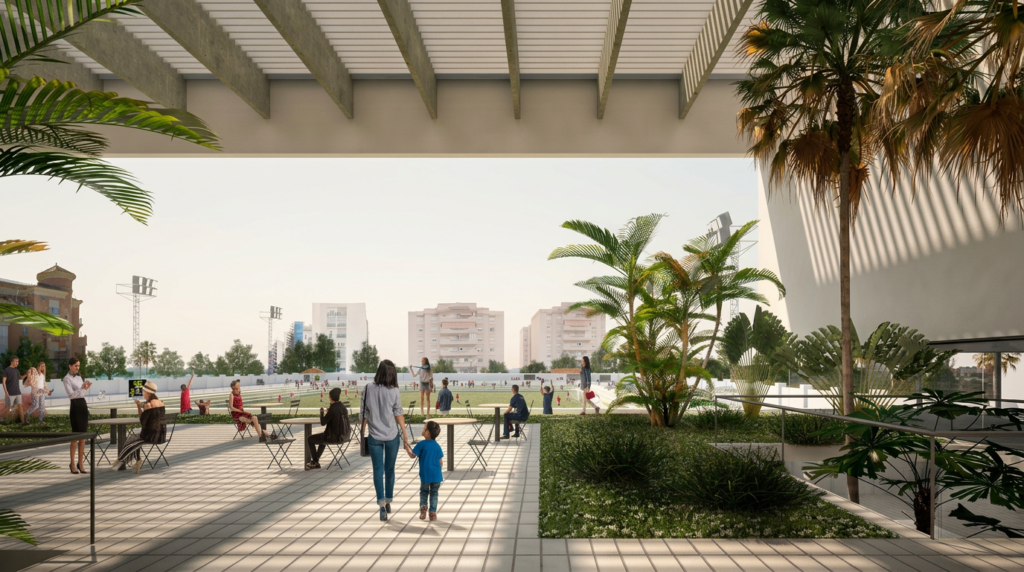
The proximity of the stadium gives the proposal an urban scale. The pool is not conceived as an isolated object, but as part of a wider concentration of sporting uses with the potential to generate activity beyond the building itself.
Its presence is deliberately clear and identifiable: a volume able to act as a visual reference and, at the same time, as a catalyst for new activity around sport.
The project is therefore considered not only from within, but also through arrival, recognition and the relationship it establishes with the spaces around it.
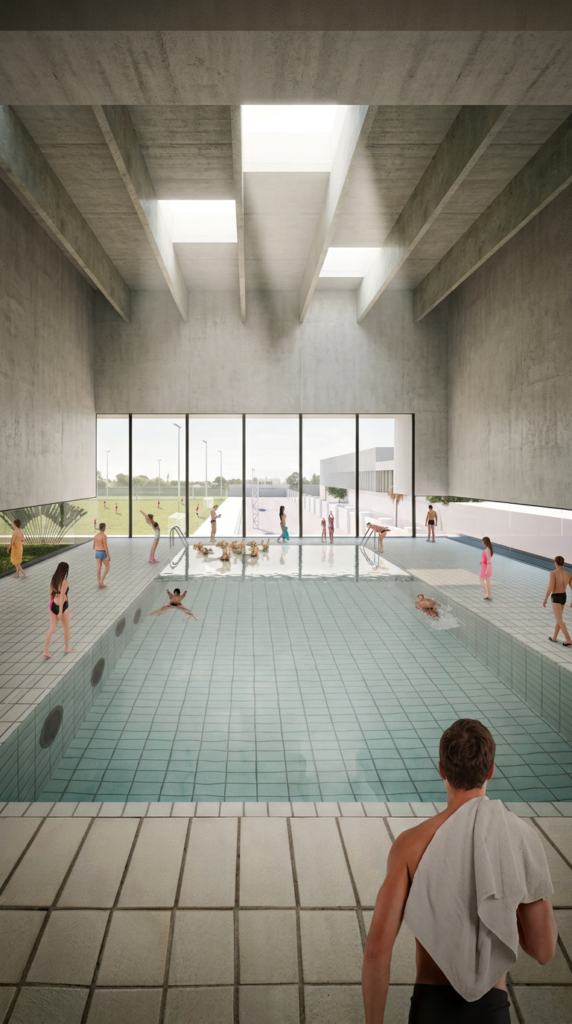
An indoor pool requires environmental control, protection and precise technical organisation. Those requirements, however, do not have to result in a sealed building.
The proposal seeks an open, daylight-filled character. Views outwards and the presence of landscape allow sporting activity to remain connected to the city beyond.
Architecture provides the necessary shelter without surrendering a sense of openness.
The Mediterranean is not immediately beside the site, yet it belongs to Estepona’s identity and to the way the project is conceived.
Its presence is less literal: it can be found in daylight, in the openness of the spaces and in an architecture that extends the experience visually towards the outside.
The aim is not to represent the sea, but to recognise landscape and climate as part of everyday urban life.
A sports building does not necessarily begin at its entrance.
Arrival spaces, planting and exterior relationships can extend the life of the building, creating places to meet before and after sport.
The pool can therefore be understood as urban infrastructure: a place where uses, routes and people come together, allowing sport to activate public space rather than remain contained within a single volume.
When a public building occupies a significant position in the city, its responsibility extends beyond functional resolution.
It must fulfil its programme, but it can also orientate, gather, give identity and alter the way a place is used.
In Estepona, the proposal begins with that possibility: an open, luminous and recognisable pool building connected to the stadium and the wider landscape.
Not simply another swimming pool.
But a place capable of activating its surroundings and bringing together new ways of experiencing sport.
MUKA arquitectura’s proposal for the Estepona indoor swimming pools received second prize in the competition.
The public sports project was developed in 2018 for the municipality of Estepona.